

How many critical paths we might have in one construction project
Understanding and managing the critical path is crucial for efficient project management because it allows you to identify potential risks and where delays could have the most impact on the project’s overall timeline.
What is the critical path?
the critical path is the longest sequence of tasks that must be completed to execute a project. The tasks on the critical path are called critical activities because if they’re delayed, the whole project completion date will be delayed. Which means that those activities have a total float with zero value.
How to calculate the critical path and the critical activities
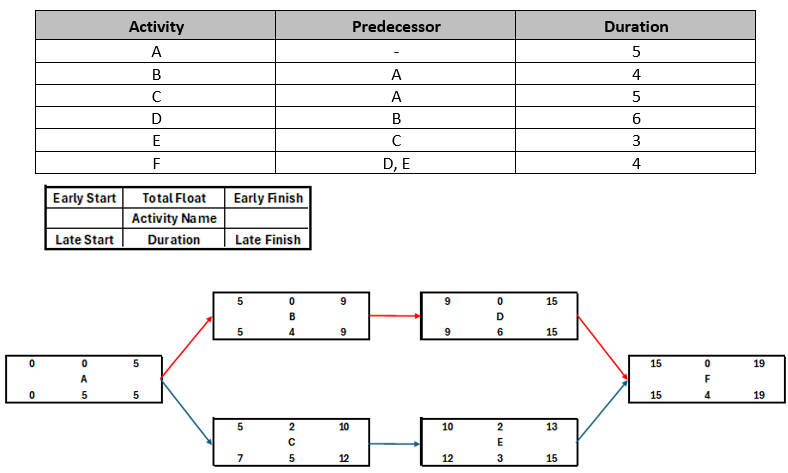
After breaking down the scope into activities with known durations, you can draw a diagram to know the critical activities.
Example.
Ready to take your skills to the next level? 🚀 Check out our Special Online Courses! 🚀
Gain valuable insights, boost your career, and learn from industry experts.
Total Float= Late Finish (LF) – Early Finish (EF)
or
Total Float = Late Start (LS) – Early Start (ES)
The critical path in this example is A-B-D-F since they have zero total float. You can read more about how to draw the network here.
Also, on Primavera P6 we can find that it was one path
Critical branches on the same critical path
The number of critical branches on the same critical path in a project is defined by the project schedule complexity and activity relationships.
In theory, a project can contain an unlimited number of critical activities. A critical path is the longest sequence of activities that determines a project’s minimum completion time. If numerous task sequences have the same total duration and are all the longest, each of them is termed a critical branch.
Factors that may result in many critical branches include:
- Parallel Activities: If many activities can occur parallel and have the same duration, each sequence could form a critical branch.
- Shared Dependencies: If different activity sequences share common dependencies with the same duration, these sequences may become critical branches.
- Project Complexity: Larger, more complex projects with several interdependent tasks are more likely to have several critical branches.
Example.

Primavera Online Basic Course -English
Online Primavera P6 Course for Engineers & Construction Managers Learn how to use Oracle Primavera P6 to plan, schedule, monitor, and control…
- 5,400 students
- WhatsApp support group
- Certificate
Total Float= Late Finish (LF) – Early Finish (EF)
or
Total Float = Late Start (LS) – Early Start (ES)
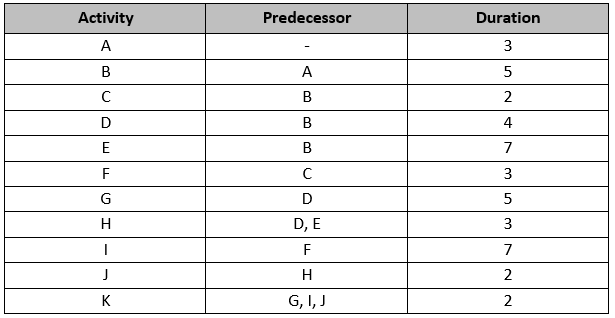
In this example, we have one critical path, and it starts with activity A and finishes with activity K. However, we have two branches of critical activities between activity A and activity K which are A-B-C-F-I-K and A-B-E-H-J-K.
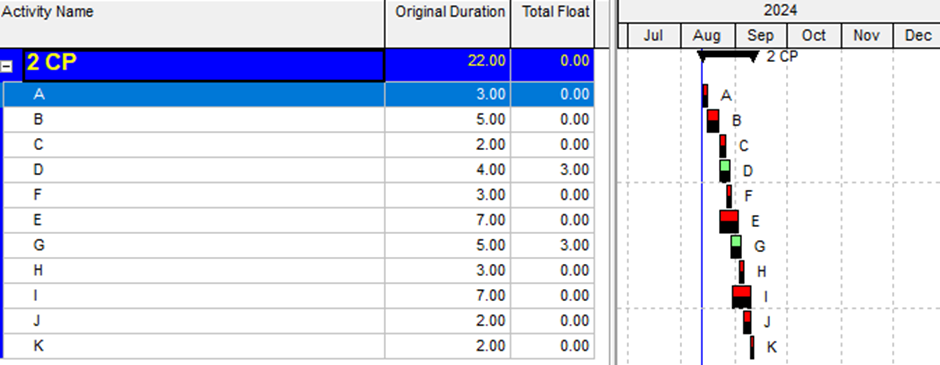
In primavera P6 if we filtered by critical. Primavera will count the two branches as critical, but they do have the same start and finish. Meaning they are on the same path, but they are different branches from the same critical path. If we used the Primavera P6 filter for critical activities.

This is the critical path which includes two critical branches.
In a case where more than one critical path can be the construction of two buildings, and they have constraints that make them start and finish at the same time, we tend to avoid that by changing the sequence of one of them to avoid high risks and delays. Or creating a start project milestone to have one critical path with critical branches throughout the whole project.
A schedule with less than 5% critical activities may contain missing logic. And if it contains more than 20% critical activities, it might suggest an aggressive schedule.
You can know the percentage of critical activities from Primavera P6. After running the schedule check the log and calculate the critical activities as a ratio to the total activities.
# Activities……………………………………………..13608
Critical Activities……………………………………….2040
Critical activities percentage = 2040/13608 =14.99%
Activities that are accepted to be critical
Some activities make perfect sense to be critical such as:
- Engineering activities for the first couple of activities in the project (E.g., delivery of concrete, shop drawing approval for plain concrete).
- Skeleton works. (Foundations, Columns, and slabs).
- Finishes and MEP works (for a specific floor, mostly the final floor).
Testing and commissioning activities.
The above-mentioned are examples that can be used as a reference, but they may vary from one project to another.
You can check our article about how you can create an indicator for critical activities in Primavera P6 here.
Near critical path activities
Some activities on the schedule may become critical because of unforeseen situations or delays. These activities have less total float and present a higher risk of turning critical. Although critical path activities receive sufficient attention, it is not practical to focus entirely on critical activities while ignoring near-critical activities.
Activities near the critical path need to be monitored and logically located. A filter can be created to spot the near-critical path activities.

Conclusion
We can have multiple branches of critical activities on the same critical path. But in the end, it is only one critical path from start to end. We tend to avoid multiple critical paths by assigning a project milestone for the whole project to decrease the high risk of delays.
Download the Resources of this Article
How many critical paths we might have in one construction project [Article] 327.67 KB 3722 downloads

Keep in Touch
Join our Email Newsletters and receive FREE weekly useful content!

Keep growing with Planning Engineer
Learn with a clear path
From Primavera P6 basics to claims, cost control and Power BI. Start with our free courses.
Browse coursesGet help on WhatsApp
Every course comes with a private WhatsApp support group where our team answers your questions.
Join a courseFind planning jobs
84 open planning and project control jobs. Post your resume so employers can find you.
See jobsGet tips by email
Free planning tips, templates and course offers. Unsubscribe any time.
Related posts:




You may also like

How to Minimize Total Float in Construction Activities

Sequence of Plaster Activity in Primavera P6

Leave A Reply
You must be logged in to post a comment.
2 Comments
This is a valuable topic.
well explained. thanks