Claims Management, Extension of Time (EOT) & Delays Analysis
Learn how to prepare, justify, and present professional construction claims and EOT submissions using practical methods and real project scenarios.
This course focuses on application — not memorization — so you can confidently handle real-life delay events and claim narratives.
- Best for: Planning Engineers, Contract Administrators, Project Managers, Construction Managers, Technical Managers
- Focus: Practical claim preparation + delay analysis + influence schedules + narrative reporting
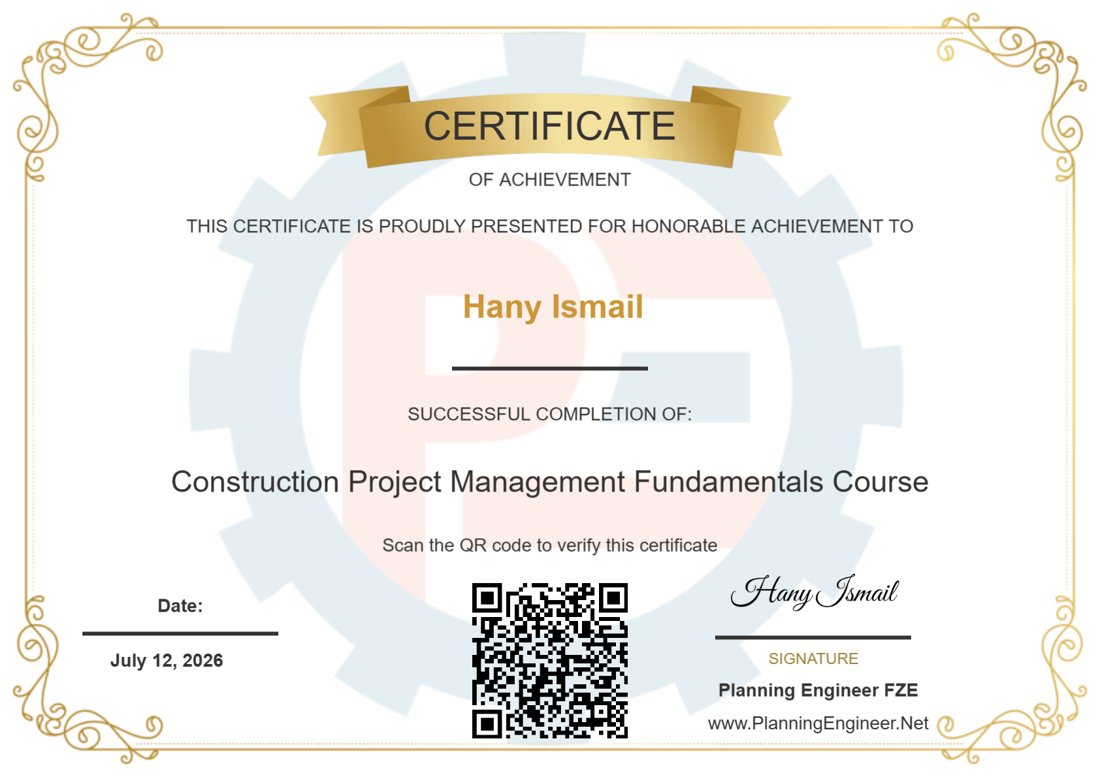
- Certificate: Yes (downloadable completion certificate)
Instructor: Hany Ismail — Planning Engineer
| Recorded Videos 5 Hours | Practicing Time 31 Hours |
| Access Lifetime Access | Prerequisites (Recommended) Construction Project Planning (Intermediate Level) with P6 + Excel |
Enroll Now
If you don’t have an account, it will be created automatically during checkout.
Why should you study claims management?

In today’s competitive construction environment, time and cost performance are critical.
Yet many projects miss deadlines, which can lead to cost escalation, disruption, and disputes.
To protect your project and your company, you need to understand delay events, contractual entitlement,
and how to prepare and present an effective Extension of Time (EOT) claim.
Unlike many courses that focus mainly on theory and memorization, this course emphasizes real-life application
of claims and delay analysis methods used in the construction industry.
Why our course, specifically?

This course is designed to help professionals become Smart, Fast, Confident, and Convincing when dealing with EOT and claims.
It is built for anyone involved in construction projects, including:
Planning Engineers, Contract Administrators, Construction Managers, Technical Managers, and Project Managers.
You will gain practical knowledge of:
construction claims, delay events, and delay analysis techniques —
and how to convert evidence into a structured claim that can be defended.
Course Overview
Claims Management and Delay Analysis involve structured steps and professional judgment.
This course challenges your thinking and guides you through the full process of preparing legitimate claims supported by proper documentation,
schedules, and clear narrative reporting.
Extension of Time (EOT) is often difficult for clients to accept. That’s why successful submissions must be:
clear, evidence-based, and professionally presented.
Course Case Study
You will work on a real case study project and practice the claims techniques taught in the course.
By the end, you will be able to develop professional claim deliverables such as:
- Finding project documents and relevant correspondences
- Developing an Events document + discussion topics for project manager
- Event templates for internal discussion and client clarifications
- Supporting letters for relevant events
- EOT log with all relevant data
- Primavera Influence schedule with all events
- 11 Influence schedules (one per event)
- Narrative claim report showing delays and entitlement logic
Certificate of Completion
Completing this course and receiving the certificate can strengthen your professional reputation and help you stand out in the job market.
It provides tangible evidence of your skills in claims management, EOT preparation, and delay analysis.
Course WhatsApp Support Group
All enrolled trainees get an invitation to the course WhatsApp support group, where our team answers your questions about claims, EOT and delay analysis. The invitation link appears at the top of every lesson after you enroll.
Download Course Contents:
Interested in a Better Value Package?
This course is included inside our Advanced Planning Package (plus two additional professional courses and bonuses).
If you want maximum value, check it here:
Advanced Planning Package
Articles Library (Continuously Updated)
We Believe in Continuous Improvement – Making Planning Easy for You!
Driven by your questions and feedback, we built an ever-growing Articles Library to support your learning journey.

Liquidated Damages in Construction Projects
Date Created: May 22, 2025 | 930 downloads
How to Verify the Progress % Complete of Activities Reported by the Contractor
Date Created: April 23, 2025 | 1385 downloads
Qualitative Risk Analysis in Construction Projects (Article)
Date Created: March 9, 2025 | 1865 downloads

Importance of Minutes of Meeting (MOM) [Template]
Date Created: January 6, 2025 | 3552 downloads
Importance of Minutes of Meeting (MOM) [Template]
Date Created: January 6, 2025 | 880 downloads
Contractor Rights and Claims Arising from Delayed Payments under Construction Contracts
Date Created: January 6, 2025 | 999 downloads
From progress override to Retained logic in an updated schedule
Date Created: December 19, 2024 | 733 downloads
How to Create Effective Risk Registers [Articles]
Date Created: November 26, 2024 | 1634 downloads

Risk Register Template
Date Created: November 26, 2024 | 2126 downloads
Common Site Acronyms in Construction
Date Created: October 17, 2024 | 1546 downloads
Join Now
Complete checkout to activate your access. If you don’t have an account, it will be created automatically during checkout.
Course Features
- Lectures 20
- Quiz 0
- Duration 36 hours
- Skill level All levels
- Language English
- Students 1875
- Certificate Yes
- Assessments Yes
Curriculum
- 11 Sections
- 20 Lessons
- Lifetime
- Lesson 2- Understand the concept of claims.2 Items
- Lesson 3- Find the events.2 Items
- Lesson 4- Collect supporting documents.2 Items
- Lesson 5- Analyse the delays.2 Items
- Lesson 6- Build your case.2 Items
- Lesson 7- Get ready to defend your case.2 Items
- Lesson 8-Time Impact window delay analysis Technique2 Items
- Lesson 9 - Contracts Module2 Items
- Print Your Certificate1 Item
- Share success and leave a review1 Item
- Support Articles Based on your Requests1 Item
Articles library
Practical articles and downloadable files for trainees on this course. New articles are added regularly.
Liquidated Damages in Construction Projects
Date Created: May 22, 2025 | 930 downloads
How to Verify the Progress % Complete of Activities Reported by the Contractor
Date Created: April 23, 2025 | 1385 downloads
Qualitative Risk Analysis in Construction Projects (Article)
Date Created: March 9, 2025 | 1865 downloads
Importance of Minutes of Meeting (MOM) [Template]
Date Created: January 6, 2025 | 3552 downloads
Importance of Minutes of Meeting (MOM) [Template]
Date Created: January 6, 2025 | 880 downloads
Contractor Rights and Claims Arising from Delayed Payments under Construction Contracts
Date Created: January 6, 2025 | 999 downloads
From progress override to Retained logic in an updated schedule
Date Created: December 19, 2024 | 733 downloads
How to Create Effective Risk Registers [Articles]
Date Created: November 26, 2024 | 1634 downloads
Risk Register Template
Date Created: November 26, 2024 | 2126 downloads
Common Site Acronyms in Construction
Date Created: October 17, 2024 | 1546 downloads
Questions & answers
Answers from our team to questions students ask in the course support group.
Lesson 2- Understand the concept of claims.
QAdditional scope was added but it is not on the critical path. Can I ask for an EOT?
If the new work does not affect your completion date, there is no EOT – request a variation order for the additional scope only.
If the new work conflicts with other work and affects the completion date, you can claim an EOT for it.
Lesson 5- Analyse the delays.
QShould the delay event be inserted in the baseline or in the updated schedule?
Insert the delay event in the updated schedule (XER) for the period in which the delay occurred. The baseline is only used as a reference.
If the event does not affect the critical path, it may show no time impact – this is normal and depends on the available float and the logic.
QAn approved recovery schedule should be the new baseline, but P6 still shows the original durations for activities that were in progress. How do I fix it?
For the current situation:
- If possible, fix the recovery schedule by splitting each in-progress activity into two: one completed and one not started. Then assigning it as a baseline will not cause significant issues.
- If that is not possible, do not assign the recovery schedule as a baseline in P6. Instead, check the planned dates of the impacted activities manually from the approved version.
To avoid it in future projects:
- Avoid using an updated schedule as a baseline, recovery or revision – a baseline should always be without updates.
- If the client insists on including the updates, split the in-progress activities into a completed part and a not-started part. The issue always comes from ongoing activities.
Lesson 6- Build your case.
QI cannot download the "Successful EOT Steps" and final EOT log files from Lesson 6. Where can I get them?
Try right-clicking the link and choosing "Save link as". You can also download them here:
Lesson 7- Get ready to defend your case.
QAn event lasted 16 days but delayed the project by 26 days. How do I justify this to the client?
First check the total float to show the impact on the whole project – the variance alone is less accurate. Depending on your case, you can explain that:
- the event disrupted critical path activities;
- resource constraints during and after the event slowed progress while teams recovered and remobilised;
- the delay cascaded to successor activities, pushing each one further than the event duration;
- cumulative and indirect impacts extended the overall delay.
QAs a consultant, how do I review an EOT claim received from a contractor?
- Check the contract: the notice period and the documents required to submit a claim.
- Check that the claim uses the delay analysis method required by the contract (e.g. As-Planned vs As-Built, Impacted As-Planned, Windows Analysis).
- Analyse each event and find the records that prove when it happened (e.g. shop drawing submission and approval dates from the log vs the agreed review period).
- Verify that no reasonable alternative could have avoided the delay.
- Identify gaps or inconsistencies that need clarification.
- Evaluate the impact on the project timeline and respond to each point.
- Determine entitlement to time and/or cost under the contract.
- State whether the claim is accepted, rejected or needs negotiation, with reasons and any conditions.
Adapt the steps to each case.
Lesson 8-Time Impact window delay analysis Technique
QWindow (time slice) analysis: out-of-sequence progress, changed logic, and delays that start in the middle of a window
- Out-of-sequence progress – do not remove it manually in a delay analysis. Keep it visible so the analysis reflects what happened on site, and use Retained Logic in the schedule options.
- Logic changed later to improve the completion date – use the relationships that were valid in that window, not later corrections. Explain in the narrative that the logic was changed afterwards.
- Delay starting mid-window – update the schedule to the data date just before the event, insert the delay event, then run the impacted schedule. For several delays in one window, use sub-windows and keep the chronology; for overlapping delays, assess concurrency and state whether each is excusable, compensable or both.
QIn a retrospective window analysis, how do I add a fragnet for additional works that span several windows?
Unless the contract specifies the delay analysis method, you can agree with the client on the method that best fits the project.
In a retrospective analysis (per AACE, with the full benefit of hindsight), choose the window date after the delay event and add the events that occurred before the data date. A fragnet should group events that are close in time and connected; events at different dates belong in separate fragnets. Events expected after the data date can be covered in a later EOT using a prospective method.
Lesson 9 - Contracts Module
QCan I still claim an EOT if I missed the contractual notice period?
It depends on the contract, the governing law and the circumstances. Many contracts (FIDIC, NEC, JCT) make timely notice a condition precedent – for example FIDIC 2017 Clause 20.2.1 – so a late notice can cost you the entitlement.
You may still have a case if:
- the employer or engineer knew of the delay and dealt with it without insisting on the notice (waiver);
- the delay was caused by the employer's own act or omission;
- it was a force majeure or exceptional event;
- the governing law applies good-faith principles, or the employer suffered no prejudice from the late notice.
Practical steps: submit the claim now with full details and the reasons for the late notice, show that the employer was not prejudiced, negotiate, and take legal advice if it escalates.
No questions match your search.