
Why Equal Manhours Don’t Mean Equal Progress: Understanding Schedule Variance in Construction
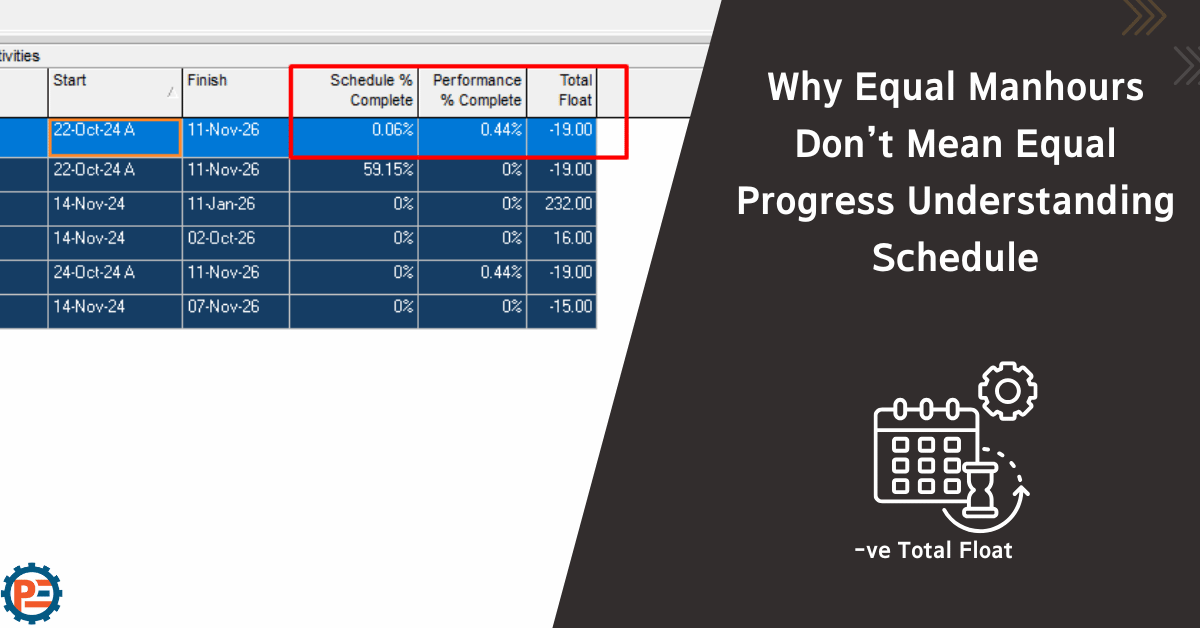
Is it possible in Primavera P6 for a project’s Performance Percentage Complete to be higher than the Scheduled Percentage Complete yet still have negative float?
A scenario that can often cause confusion among planners and project stakeholders. This disagreement arises due to the nature of critical path scheduling and total float calculations, rather than simply looking at overall progress. While the project may appear ahead in terms of work completed, delays on the critical path can still push key milestones beyond their contractual deadlines, resulting in negative float. In this article, we will explore how critical path analysis, total float, and schedule logic influence this situation and provide clarity on why progress alone does not always indicate a healthy project schedule.

Ready to take your skills to the next level? 🚀 Check out our Special Online Courses! 🚀
Gain valuable insights, boost your career, and learn from industry experts.
Critical Path Logic and Total Float
The critical path is the longest sequence of dependent activities in a project that determines the shortest possible project duration. In other words, it represents the path of activities with zero total float, meaning any delay in these activities will directly impact the project’s finish date.
Total Float (TF) is the amount of time an activity can be delayed without delaying the project’s overall completion date or a contractual milestone.
You can learn more about scheduling and planning terminologies, such as critical path and total float, from our Construction Project Planning Intermediate Level with P6 course.
Key Characteristics of the Critical Path and the Total Float:
- It identifies the most time-sensitive tasks.
- Activities on the critical path have no flexibility (float = 0), meaning any delay will directly affect the project completion date.
- Delays in these activities extend the project’s completion date unless corrective actions, such as acceleration or recovery strategies, are applied.
- It helps planners and project managers prioritize work to meet deadlines.
This means that in the screenshot above, the contractor is working on the non-critical activities, leading to higher performance than the scheduled; however, the critical activities are causing delays in the project.
Construction Project Management Fundamentals Course
Learn how real construction projects are planned, managed, and controlled — from initiation to closing — using practical methods to deliver on…
- 7,689 students
- WhatsApp support group
- Certificate
Case Study: Two Approaches to Handling Negative Float with High Performance Percentage Complete
In project management, different managers may adopt different strategies when faced with the same scheduling challenge. This case study examines two managers handling a project where the Performance Percentage Complete is higher than the Scheduled Percentage Complete, yet the project still has Negative Float. While both managers recognize the issue, their approaches to resolving it differ based on their understanding of the critical path, total float, and schedule adjustments.

Manager No.1: Kept working randomly without referring to the time schedule to check the critical activities. He kept working on increasing the Performance Percentage Complete without considering the Negative Float. He spent 100’s of hours working, yet the project was delayed, leading to penalties.
Manager No.2: Referred to the time schedule to check the critical activities to maintain the delays and focus more on decreasing the delays. He spent 100’s of hours decreasing the delays, which helped him avoid penalties.
From this case study, it is evident that the manager who focused on critical activities and understood the critical path logic performed better in managing the project’s scheduling challenges. By strategically addressing the activities that directly impacted the project’s completion date, this manager was able to reduce negative float, making informed decisions without wasting unnecessary time or resources. [Manager No.2]
On the other hand, the alternative approach, which prioritized overall progress without targeting the critical activities, resulted in inefficient resource allocation and did not effectively mitigate delays.
[Manager No.1]
Understanding the Concept of Sequencing Activities
Manager No.1 worked on non-critical activities such as the external works around the building (planting, street lighting fixtures, etc.). These activities caused the performance percentage to increase because they have a cost, but they are not critical activities.
Meanwhile, Manager No.2 focused on why the critical activities are being delayed, so he found out that the columns of the second floor need to be poured immediately to continue working on the critical path and decrease the negative float.
Understanding the sequencing concept is very important in planning. While constructing a building the structure works (Foundation, columns and slabs) are critical because the project depends on finishing them so the finishing and MEP can start, that is why it is important to focus on the structure works of the building, other works can be done in the project but they can be delayed, such as the fence around the building, this accounts for a cost and is as important as any other part in the schedule because it is part of the scope. However, if we delay the fence for a while, it will not affect the building, which surely requires more time; that is why it is critical.
Conclusion
In Primavera P6, seeing a higher Performance Percentage Complete than the Scheduled Percentage Complete while the project still has negative float can be confusing at first. However, understanding the critical path and total float makes it clear. The performance percentage only reflects the work completed relative to the plan, while the negative float signals that critical activities are behind schedule and threatening the project’s completion date.
Download the Resources of this Article
Why Equal Manhours Don’t Mean Equal Progress: Understanding Schedule Variance in Construction 257.33 KB 896 downloads

Keep in Touch
Join our Email Newsletters and receive FREE weekly useful content!

Keep growing with Planning Engineer
Learn with a clear path
From Primavera P6 basics to claims, cost control and Power BI. Start with our free courses.
Browse coursesGet help on WhatsApp
Every course comes with a private WhatsApp support group where our team answers your questions.
Join a courseFind planning jobs
87 open planning and project control jobs. Post your resume so employers can find you.
See jobsGet tips by email
Free planning tips, templates and course offers. Unsubscribe any time.
Related posts:




You may also like

How to Minimize Total Float in Construction Activities

