

The Role of a Planning Engineer During and After Project Completion
The project close-out phase is a crucial stage in the lifecycle of any construction or engineering project, signifying the completion of all activities and fulfillment of contractual requirements. This phase involves essential tasks for a planning engineer to ensure a smooth transition, compliance, and thorough documentation. Below is an overview of the key responsibilities of a planning engineer during project execution and after project completion.
Responsibilities of planning engineer During the Project Execution Phase
During the execution phase, a planning engineer plays a vital role in the following activities:
- Schedule Management: Develop and maintain baseline, revised, and recovery schedules.
- Progress Monitoring: Track project progress and identify delayed events.
- Documentation and Coordination: Maintain records such as minutes of meetings (MOM) and extension of time (EOT) discussions while coordinating with stakeholders.
- Stakeholder Communication: Engage with stakeholders to ensure smooth progress and timely completion of the project.

Ready to take your skills to the next level? 🚀 Check out our Special Online Courses! 🚀
Gain valuable insights, boost your career, and learn from industry experts.
Key Records Maintained During the Project
Effective record-keeping is essential for project success. The planning engineer ensures the following documents are meticulously managed:
1. Minutes of Meetings (MOM):
Accurate records capture key decisions, actions, and critical discussions.
2. EOT Correspondence:
Transparent documentation of extension of time discussions and negotiations.
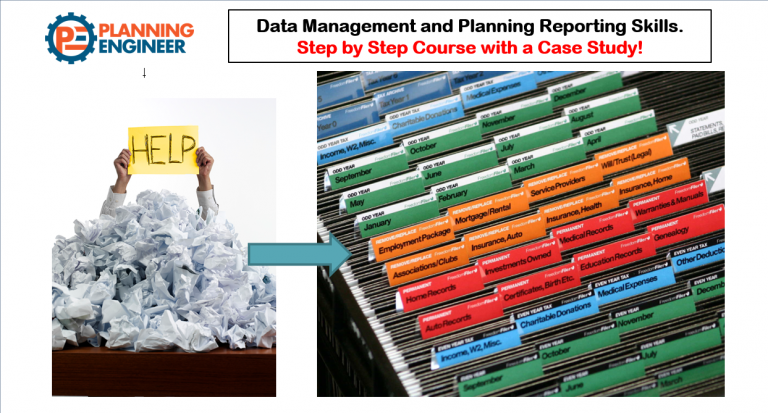
Data Management and Reporting
Data Management is the key success of construction projects reporting. This self-study course will teach you using a step by step case…
- 1,680 students
- WhatsApp support group
- Certificate
3. Schedules:
- Baseline Schedule: The initial project plan with timelines and milestones.
- Revised Schedule: Updates reflecting changes in scope, delays, or priorities.
- Recovery Schedule: Plans to realign delayed projects with their timelines.
Activities After Project Completion
Once the project is completed, the planning engineer’s responsibilities shift to closure and analysis tasks, including:
1. Preparation for Handing Over Certificates:
Ensure all substantial and final completion certificates are prepared, signed, and submitted.
2. Lessons Learned:
Document challenges, successes, and recommendations for future projects.
3. Subcontractor Evaluation:
- Top Performers: Identify subcontractors who delivered quality work on time and within budget.
- Underperformers: Highlight subcontractors who failed to meet expectations.
4. Crew Performance Evaluation:
- High-Performing Crews: Crews with excellent productivity and quality.
- Underperforming Crews: Crews with delays or subpar work quality.
5. Supplier Performance Evaluation:
- Reliable Suppliers: Suppliers who deliver on time at competitive prices.
- Unreliable Suppliers: Suppliers with delayed deliveries or higher costs.
6. Delay Analysis and Prevention:
Identify delayed activities and recommend strategies to avoid similar delays in future projects.
7. Updating Productivity Rates:
Update the company’s productivity database for better future estimates.
8. Planned vs. Actual Productivity Analysis:
Analyze discrepancies to identify areas for improvement.
Closing the Loop: Leveraging Data for Future Success
The insights gathered during and after the project are invaluable for enhancing organizational practices. Detailed documentation, evaluations, and analyses by the planning engineer contribute to:
- Improved Planning Accuracy: More reliable estimates for future projects.
- Data-driven decision-making: A robust repository of records for scheduling and resource planning.
- Continuous Improvement: Enhanced selection processes for suppliers and subcontractors.
Conclusion
The role of planning engineer extends beyond project completion. It encompasses the critical tasks of documentation, performance analysis, and the dissemination of insights to refine project management practices. By doing so, planning engineers play a pivotal role in driving continuous improvement and ensuring the success of future projects.
Download the Resources of this Article
The Role of a Planning Engineer During and After Project Completion 313.12 KB 876 downloads

Keep in Touch
Join our Email Newsletters and receive FREE weekly useful content!

Keep growing with Planning Engineer
Learn with a clear path
From Primavera P6 basics to claims, cost control and Power BI. Start with our free courses.
Browse coursesGet help on WhatsApp
Every course comes with a private WhatsApp support group where our team answers your questions.
Join a courseFind planning jobs
84 open planning and project control jobs. Post your resume so employers can find you.
See jobsGet tips by email
Free planning tips, templates and course offers. Unsubscribe any time.
Related posts:





You may also like


S-Curve from Primavera P6 [Template]
