Critical Chain Project Management (CCPM) in Construction
In the construction industry, projects are often troubled by delays, bottlenecks in resources, and poor schedules which result in overspending and breach of contracts. These challenges have been tackled for a long time now through various project management approaches, for example, the use of the Critical Path Method (CPM). However, CPM frequently overlooks the operational limits of resource inputs and the outcomes of multitasking.
Here comes Critical Chain Project Management (CCPM), CCPM departs from conventional project management by reducing project uncertainties through orderly organization of resources, control of buffers, and appropriate sequencing of tasks. This article discusses how construction projects can implement CCPM and the benefits it offers as compared to the other methods.
Understanding Critical Chain Project Management (CCPM)
The Critical Chain is the longest path in the network diagram that takes into consideration task dependency and resource availability. It’s a modified form of the Critical Path Method where project activities use aggressive time and, in theory, have access to unlimited resources.
Ready to take your skills to the next level? 🚀 Check out our Special Online Courses! 🚀
Gain valuable insights, boost your career, and learn from industry experts.
CCPM uses buffers as strategic points and solutions to remove project uncertainty, whereas the Critical Path Method uses Float.
A buffer is a time reserve carefully added to save the project schedule from delays due to uncertainty, restriction of resources, or dependencies on tasks. In contrast with CPM, where padding is invisible within the task duration, CCPM eliminates the hidden safety margins from the individual tasks, combining them into clearly defined buffers.
The project buffer maintains the completion date constant and prevents the project from missing its planned end date. It is placed between the final task and the completion date after the project network diagram. It protects the project completion date, which may change as a result of modifications to the critical chain’s activity durations. In other words, the size of the project buffer depends on the activities in the critical chain.

The feeding buffer comes between the final task on a non-critical chain and the critical chain. Activities that integrate into the crucial chain are known as feeding chains. In order to prevent delays on a non-critical chain from affecting the critical chain, feeding buffers are usually provided to certain merging points.
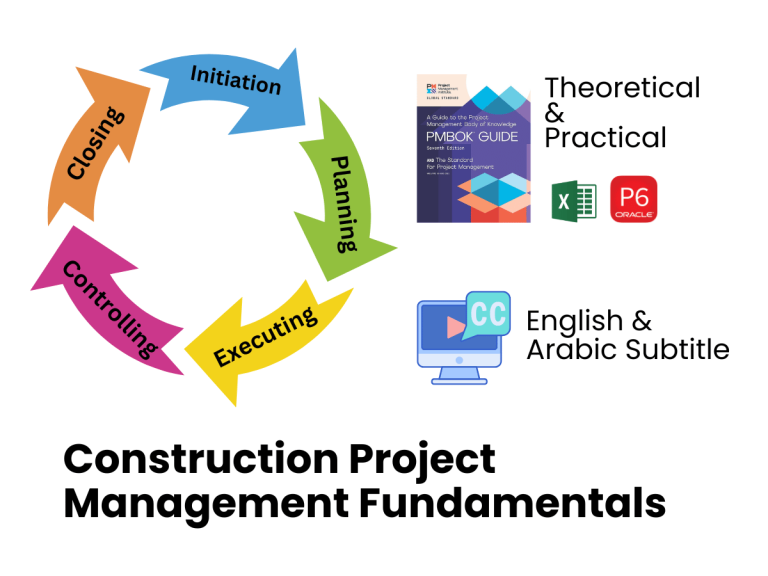
Construction Project Management Fundamentals Course
Learn how real construction projects are planned, managed, and controlled — from initiation to closing — using practical methods to deliver on…
- 7,683 students
- WhatsApp support group
- Certificate
Resource buffers: these are placed on the Critical Chain to guarantee that the necessary and suitable resources (people, equipment) are available when needed during the project. These resources are frequently known as Critical Resources.

CCPM vs. Critical Path Method (CPM): A Practical Example
Imagine a project to build a multi-story commercial building. In a traditional CPM approach, tasks are scheduled solely based on their dependencies. For instance, electrical wiring might be planned right after the structural work, even if the electricians are also needed for another task at a different location. To learn more about CPM you can check our course.
On the other hand, with CCPM, the same project would recognize resource constraints from the start. If electricians are working on several tasks, their availability would influence the order of tasks. Buffers would be strategically placed to handle delays from unexpected issues. Instead of having strict deadlines for each task, a project buffer at the end would allow for delays without impacting the overall completion date.
In this scenario, CPM could lead to resource conflicts and downtime, while CCPM makes sure resources are used efficiently and delays are managed proactively through monitoring buffer usage.

Benefits of Using CCPM in Construction
CCPM provides notable benefits in managing construction projects. By reducing multitasking and optimizing how resources are allocated, tasks are finished more quickly and effectively. The thoughtful implementation of buffers increases predictability, giving a clearer understanding of risks and safety margins. Additionally, CCPM minimizes idle time for resources and fosters better collaboration among team members by clarifying task priorities and establishing accountability. Enhanced resource efficiency and improved communication contribute to a more transparent project environment, allowing teams to proactively tackle potential issues and lessen the chances of expensive delays and disruptions.
Potential Challenges and Solutions
While CCPM offers numerous advantages, its implementation in construction projects can face pushback. Teams adapted to traditional practices may be unwilling to embrace change, and insufficient training can hinder successful adoption. Moreover, current project management software may not adequately support CCPM methodologies.
To address these obstacles, a systematic approach is essential. Providing thorough training and education for project teams helps them understand the principles and advantages of CCPM. Introducing CCPM gradually through smaller pilot projects can foster confidence and showcase its effectiveness. Additionally, investing in software tools that are compatible with CCPM can ease the integration into existing workflows.
Conclusion
Critical Chain Project Management offers a first-choice proposition in all available project management techniques due to its ability to attack resource bottlenecks, manage task prioritization, and manage buffers to cut down delays. Focusing on the critical chain and ensuring the best resource allocation allows CCPM to achieve better project performance, cut down costs, and make outcomes more predictable.
Adopting CCPM involves shifting the organization’s culture and investing in staff training and tools; this initial cost pales beside the benefits that follow. For companies in the construction industry, this means better project execution, better resource utilization, and on-time project completion.
Download the PDF version of this Article to share with your colleagues
Critical Chain Project Management (CCPM) in Construction 299.79 KB 583 downloads

Keep in Touch
Join our Email Newsletters and receive FREE weekly useful content!

Keep growing with Planning Engineer
Learn with a clear path
From Primavera P6 basics to claims, cost control and Power BI. Start with our free courses.
Browse coursesGet help on WhatsApp
Every course comes with a private WhatsApp support group where our team answers your questions.
Join a courseFind planning jobs
84 open planning and project control jobs. Post your resume so employers can find you.
See jobsGet tips by email
Free planning tips, templates and course offers. Unsubscribe any time.
Related posts:




Tag:CCPM, Critical Path Method