

What documents are required for the creation of a baseline?
Establishing a project baseline is a fundamental step in project management, providing a reference point for tracking progress, controlling costs, and ensuring timely completion. A well-structured baseline comprises three main components:
- Schedule Baseline – Defines the timeline of the project.
- Cost Baseline – Outlines the estimated budget for the project.
- Scope Baseline – Determines the scope and deliverables of the project.
To develop an effective baseline, project managers rely on several key documents, each containing essential information. This article will explore the required documents and the critical data that must be extracted from each for accurate baseline development.
1. Contract: Defining the Project’s Framework
The contract agreement is the foundation of the project, serving as a legally binding document between the client and contractor. It outlines the project’s objectives, scope, and financial terms.
Ready to take your skills to the next level? 🚀 Check out our Special Online Courses! 🚀
Gain valuable insights, boost your career, and learn from industry experts.
Data Extracted from the Contract Agreement:
- Project Start and Finish Dates:
- The official commencement and completion dates set by the client.
- Helps in developing the schedule baseline.
- Project Milestones:
- Key deadlines for completing critical phases of the project.
- Serves as checkpoints to monitor project progress.
- Total Project Cost:
- Defines the overall budget allocation.
- Forms the baseline, ensuring financial planning aligns with contractual commitments.
- Project Structure:
- Outlines how the project is divided into major phases and work packages.
- Helps in defining the Work Breakdown Structure (WBS)
- Payment Terms & Retention Policies:
- Specifies how payments will be released based on milestones or completion percentages.
- Ensures cash flow planning aligns with project progress.
- Liquidated Damages & Penalties:
- Defines the penalties for delays or contractual breaches.
- Helps in risk management and contingency planning.
The contract agreement is the primary reference document, ensuring the project is executed in compliance with contractual obligations.
2. Bill of Quantities (BOQ): Establishing Scope and Cost Components
The Bill of Quantities (BOQ) is a structured document listing all materials and Items required for project execution.
Data Extracted from the BOQ:
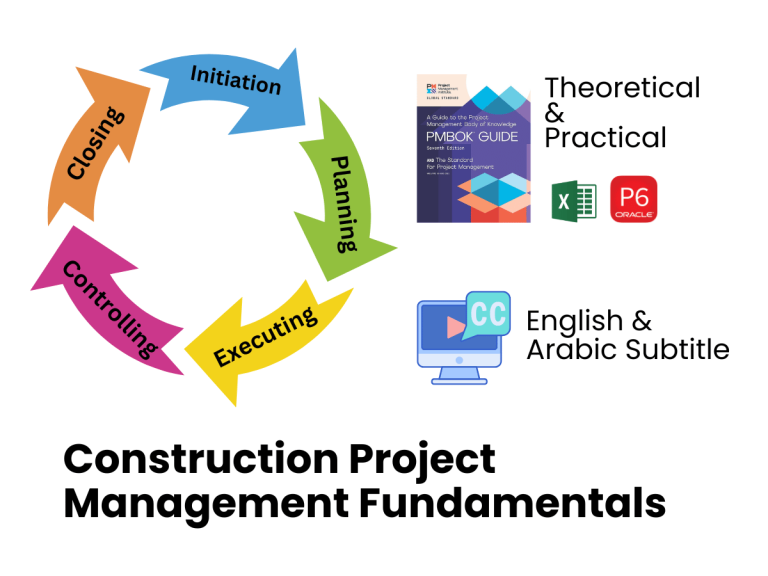
Construction Project Management Fundamentals Course
Learn how real construction projects are planned, managed, and controlled — from initiation to closing — using practical methods to deliver on…
- 7,689 students
- WhatsApp support group
- Certificate
- List of Work Activities & Corresponding BOQ Items:
- Each work item is categorized with a description to be assigned for the Activity, making it easy to align with the schedule and WBS.
- Quantities and Measurement Units:
- Specifies the required quantity for each activity (e.g., cubic meters of concrete, and tons of steel).
- Helps in estimating material requirements and procurement needs.
- Unit Rates & Total Cost Per Item:
- Defines the cost per unit of work (e.g., per square meter of tiling).
- Assists in budget allocation and forms the basis of resource-leveling.
- Activity Classification & Phases of Work:
- BOQ is often structured according to project phases (excavation, foundation, superstructure, finishing, etc.).
- Supports logical sequencing in the schedule baseline.
By integrating the BOQ into the baseline, planners can accurately define the cost and schedule components for each phase of the project.
3. Project Drawings: Clarifying the Scope and Execution Plan
Design and Shop drawings are essential for visualizing the project and understanding the placement of BOQ items. They ensure that activities align with the project’s technical and structural requirements.
Data Extracted from the Drawings:
- Locations of BOQ Items & Work Zones:
- Identifies the exact locations for materials, installations, and construction elements.
- Helps in distributing the BOQ Items into floors or zones
Drawings serve as a blueprint for execution, ensuring that all work aligns with the scope, cost, and schedule baselines.
4. Tender or Preliminary Schedule (If Available)
1. Initial Time Estimates (used as a reference for detailed scheduling).
2. High-Level Activity Sequencing (provides a starting framework).
5. List of Key Deliverables & Approvals
- Procurement & Material Approval Deadlines (influencing lead times).
- Client-supplied equipment or Materials (timing dependencies).
- Permitting & Authority Approvals (impacting start dates of critical activities).
Final Thoughts: How These Documents Build a Strong Baseline
A well-established project baseline integrates data from multiple sources, ensuring alignment between:
- Scope Baseline → Defined by contract, BOQ, and drawings.
- Cost Baseline → Developed using BOQ, and contract cost.
- Schedule Baseline → Built using WBS, BOQ, and project schedule.
By extracting the correct data from each document, project managers can create a realistic and achievable baseline, minimizing risks and ensuring successful execution.
Download the Resources of this Article
What documents are required for the creation of a baseline? 249.09 KB 1305 downloads

Keep in Touch
Join our Email Newsletters and receive FREE weekly useful content!

Keep growing with Planning Engineer
Learn with a clear path
From Primavera P6 basics to claims, cost control and Power BI. Start with our free courses.
Browse coursesGet help on WhatsApp
Every course comes with a private WhatsApp support group where our team answers your questions.
Join a courseFind planning jobs
87 open planning and project control jobs. Post your resume so employers can find you.
See jobsGet tips by email
Free planning tips, templates and course offers. Unsubscribe any time.
Related posts:






You may also like

How to Minimize Total Float in Construction Activities

