

Planned Spent Hours: A Tool for Monitoring Project Progress
1. Introduction
Planned Spent Hours offers valuable insights into project advancement, focusing on the effort expended. Unlike Earned Value Management (EVM), which primarily considers financial aspects, Hours examines working hours and actual progress. This article provides a detailed exploration of PSH and its role in project monitoring.
A. Calculating Required Working Hours for a Project
Determining the necessary working hours involves several steps:
o Resource Loading Sheet Preparation: Develop a resource loading sheet detailing tasks and quantities.
Ready to take your skills to the next level? 🚀 Check out our Special Online Courses! 🚀
Gain valuable insights, boost your career, and learn from industry experts.
o Allocation of Productivity Rates: Assign productivity rates to tasks to estimate the time needed.
o Deriving Budgeted Working Hours: Multiply task quantities by productivity rates to calculate budgeted working hours.
For instance, if a task requires 100 square meters and each square meter takes 10 hours, the total working hours needed would be 100 * 10 = 1000 hours.
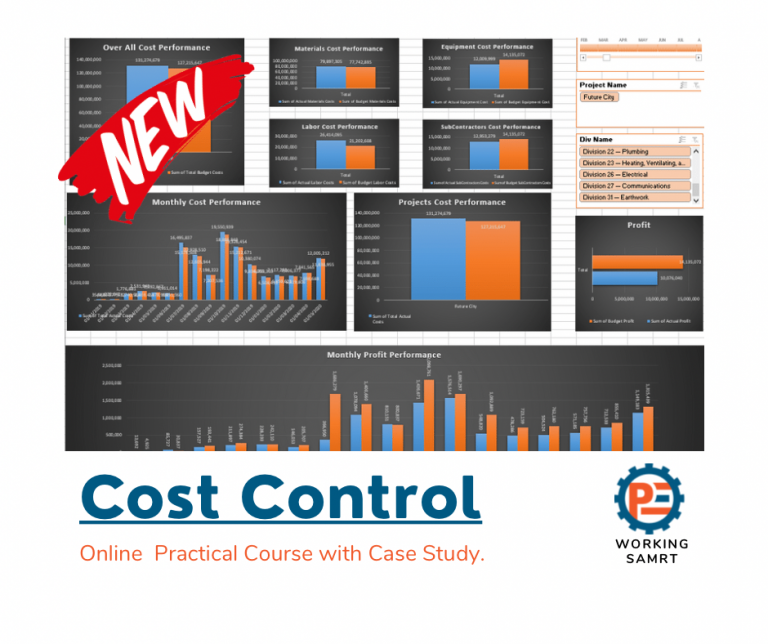
Cost Control for Construction Projects
Course WhatsApp Support Group All enrolled trainees get an invitation to the course WhatsApp support group, where our team answers your questions…
- 810 students
- WhatsApp support group
- Certificate
B. Calculating Planned Spent Hours
To compute it, follow these steps:
o Determining Planned Percentage of Completion: Assess planned progress as a percentage for each task.
o Computing Planned Spent Hours: Multiply the planned completion percentage by task hours to find planned hours.
o Total Planned Hours: Sum planned hours across all tasks to determine the project’s total planned hours.
o Calculating Planned Percentage: Divide total planned hours by total project hours to find the planned percentage.
C. Enhancing Project Monitoring
While EVM is valuable, supplementing it with Planned Hours offers a more comprehensive view. This combination mitigates issues like cost front or back loading, enabling informed decision-making for project success.
D. Further Learning Opportunities
Consider enrolling in courses like the Professional Planning Engineer Course for deeper insights into project planning and monitoring techniques.
By integrating Planned Hours with EVM, project stakeholders gain an understanding, facilitating effective project management and successful outcomes.
2. Conclusion:
Earned Value Management or EVM is widely used in projects monitoring. However, due to some issues with front or back loading of costs, you may need another factor for evaluating the project. The level of effort of working hours could be a very effective method to be used along with EVM for proper monitoring. If you want to know more about how to use both planning techniques for a mega construction project, I would advise you to enroll in the Professional Planning Engineer Course.
Download the Resources of this Article
Planned Spent Hours: A Tool for Monitoring Project Progress 195.11 KB 2991 downloads

Keep in Touch
Join our Email Newsletters and receive FREE weekly useful content!

Keep growing with Planning Engineer
Learn with a clear path
From Primavera P6 basics to claims, cost control and Power BI. Start with our free courses.
Browse coursesGet help on WhatsApp
Every course comes with a private WhatsApp support group where our team answers your questions.
Join a courseFind planning jobs
87 open planning and project control jobs. Post your resume so employers can find you.
See jobsGet tips by email
Free planning tips, templates and course offers. Unsubscribe any time.
Related posts:





You may also like

How to Minimize Total Float in Construction Activities

Sequence of Plaster Activity in Primavera P6

Leave A Reply
You must be logged in to post a comment.
1 Comment
Sure sir, looking forward to join advance planning course.